






In February 1875, Dugald Mackichan left his home in London for the long voyage to Bombay. A 24-year-old missionary of the Free Church of Scotland, his primary goal in India was to serve his mission. But over the next 45 years, Mackichan left a much deeper legacy – as a leading academic and as a scholar of Sanskrit and Marathi.
Mackichan’s impressions of life in Bombay were compiled in the book Forty-Five Years in India. Though biographical, the book also serves as a valuable historical account of the city, particularly its political and social life during colonial rule, as well as of episodes such as the 1896 plague.
His reflections were shaped in part by his status in the city. Within a year of his arrival, Mackichan was appointed principal of Wilson College, succeeding its founder John Wilson. He would go on to serve four terms as vice-chancellor of Bombay University.
Racial segregation
Mackichan’s memoir reveals a particular fondness for Donald Mackay or Lord Reay, the governor of Bombay from 1885 to 1890, after whom Reay Road station on the city’s suburban rail network is named.
“From his time of arrival, Lord Reay set himself to the task of bringing the Europeans and Indians into closer relations,” Mackichan wrote. “The functioning at Government House, for example, assumed a new aspect. Among the guests, whether at dinner-parties or at crowded receptions, were larger number of Indians, and this tradition has been maintained by all his successors.”
Mackichan found that Reay had a similarly inclusive outlook on the issue of racial segregation in public spaces like the railways. He criticised the common colonial justification for separate railway coaches for Europeans and Indians:
“I know that many of our countrymen seek to justify this opposition to mixed travelling by reference to a difference between the ways of the two peoples. It may be true that separate travelling may be more comfortable for both by reason of these differences; but it is impossible with any justice, to insist upon this.”
He said Indians had learned to “adapt themselves” to the exigencies of rail travel. “My own experience of Indian fellow-travellers has taught me that they are sometimes much more interesting fellow-travellers than some of our own people,” he observed. “I have travelled for a whole day with an Englishman who remained silent and apart through all the hours; I have travelled rarely with Indians without receiving pleasure and instruction from their companionship.”

Widespread anger
While Mackichan seemed to have genuine affection for Indians, and his institution, Wilson College, was known for admitting children of freedom fighters, the Scot was not supportive of Indian independence.
This became evident in his harsh assessment of Vasudev Balwant Phadke, the revolutionary who led armed raids during the 1877 famine. While acknowledging widespread anger at the colonial government’s insufficient relief efforts, Mackichan dismissed Phadke as the leader of a band of dacoits:
“A very long-continued and well-organised system of dacoity began and this time to harass the afflicted people. A Brahman of Poona [Phadke] was the head of these robbers of the villages. He was credited with being the originator of the fire which destroyed the ancient Budhvar palace of the Peshvas in Poona as well as of this system of robbery which was spreading over the district.”
Phadke and his men were known to loot government treasuries and the homes of Indian elites who were believed to be British collaborators, redistributing grain and money to the poor. Mackichan, however, downplayed the movement’s popularity: “No one attached to these occurrences the significance of a rising; but it was felt that the presence of a troop of cavalry would give a feeling of assurance to the inhabitants of the station.”
Eventually, the British managed to catch the revolutionary and his band. “He was afterwards exiled to Aden, where he was kept in confinement for several years,” Mackichan wrote.
Bubonic plague
During his long stay in Bombay, Mackichan also witnessed the devastating outbreak of bubonic plague in 1896. “The exodus from Bombay was a striking feature in the first year of the plague,” he wrote.
He described Gujarati tailors waiting at stations at Queen’s Road, sewing machines beside them, ready to escape the city. He also observed the rise in demand for wood for funeral pyres. “One could gauge the increasing mortality by the number of bullock-carts laden with wood outside the high wall of the burning ground,” he wrote. “The acrid smoke which filled the atmosphere at this point told the same sad tale.”
Mackichan praised Russian bacteriologist Waldemar Haffkine for developing a vaccine, though he noted widespread suspicion among educated and uneducated Indians about inoculation.
“Especially to a Hindu, there was something repellent in this introduction of a poisonous, and, as he would naturally think, unclean substance into his body,” he wrote. “However, the inoculation campaign made very considerable progress, and many of the most orthodox Hindus were led to avail themselves of it.”
He recounted changing the attitude of students at Wilson College after one of them – who was “distinguished” and “promising” – died of the plague. “I assembled the students, and with all the urgency I could summon, called upon them to take advantage of the protection afforded by this inoculation,’ Mackichan wrote. “A Poona Brahman, himself a leading student and the head of the opposition to the inoculation amongst the students, stood up and offered to submit himself to the operation. His example inspired a number of others, and these were all inoculated.”
Sensitive people
Before arriving in India, Mackichan spent three months in Germany studying Sanskrit. In Bombay, he continued his study of the language while also learning Marathi in order to preach and connect with the local population.
“He had to preside frequently at functions, and take his turn in preaching in English and in Marathi,” Mackichan’s daughter Marie A Service wrote in a chapter of Forty-Five Years in India.
Although he made every attempt to understand and befriend the people of Bombay, it frustrated him that the colonial authorities made little effort. He was perhaps blinded by his belief in the inherent goodness of the Empire.
“Indians are a sensitive people, and a single act or word which wounds their self-respect will consign to oblivion a lifetime of generous benevolence,” he wrote. “In no other way can the failure of our Government of India, one of the most benevolent specimens of human rule, to win the heart of India be explained. Three centuries of beneficent association between the British and Indian races have left us to-day not only with the gulf between the peoples unbridged, but with an antagonism that is threatening revolution continually.”

Notable progress
Dugald Mackichan died in Scotland in April 1932 at the age of 81. His family received condolences from both Indian and British friends and former students in Bombay.
“During his Principalship the [Wilson] College made notable progress,” The Glasgow Herald wrote on April 8, 1932. “The number of students increased from about 200 to over 1000, and Dr. Mackichan raised money for the building of a new college without assistance from the Foreign Missions Committee of his Church.”
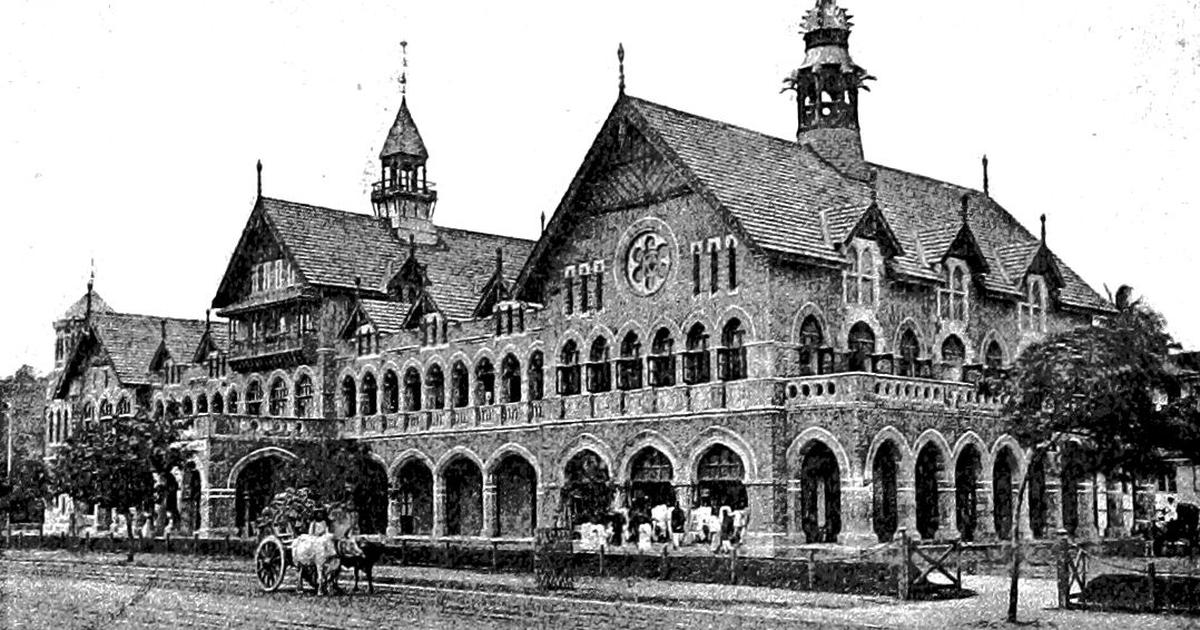
The boys’ hostel at Wilson College still bears his name, and its hall and lawn remain popular venues for weddings – a quiet testament to the legacy of the Scottish academic who called Bombay home for nearly half a century.
Ajay Kamalakaran is a writer, primarily based in Mumbai. His Twitter handle is @ajaykamalakaran.
